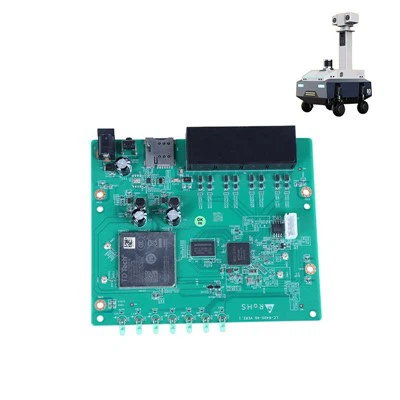
In the rapidly evolving landscape of the Internet of Things (IoT) and Artificial Intelligence (AI), the AIoT Control Gateway has emerged as a pivotal component. As a leading supplier of AIoT Control Gateway, we understand the significance of device support in making the AIoT ecosystem truly functional and efficient.
Understanding the AIoT Control Gateway
The AIoT Control Gateway serves as a bridge between various devices and the cloud or other central systems. It is responsible for collecting data from different devices, processing it, and then transmitting it to the appropriate destinations. This gateway not only provides connectivity but also adds intelligence to the data flow, enabling better decision - making and automation.
Importance of Device Support
The support for different device types in an AIoT Control Gateway is of utmost importance. In a real - world scenario, there is a wide range of devices with different communication protocols, data formats, and power requirements. A gateway that can support multiple device types can create a unified and seamless IoT network.
1. Connectivity and Interoperability
One of the primary functions of an AIoT Control Gateway is to establish connectivity between different devices. Different devices may use various communication protocols such as Wi - Fi, Bluetooth, ZigBee, LoRaWAN, and Ethernet. Our AIoT Control Gateway is designed to support a wide range of these protocols, ensuring that it can communicate with different types of devices, including sensors, actuators, smart meters, and industrial equipment.
For example, in a smart home environment, there could be Wi - Fi - enabled smart bulbs, Bluetooth - connected thermostats, and ZigBee - based door sensors. Our gateway can connect to all these devices simultaneously, allowing users to control and monitor them from a single AIoT Control Panel.
2. Data Aggregation and Processing
Different devices generate data in various formats. Some sensors may produce analog data, while others generate digital data. Our AIoT Control Gateway is equipped with advanced data aggregation and processing capabilities. It can convert different data formats into a unified format, making it easier to analyze and utilize the data.
For instance, in an industrial setting, there may be temperature sensors that provide analog data and pressure sensors that generate digital data. The gateway can collect this data, convert it into a common format, and then send it to the cloud for further analysis. This aggregated data can be used to optimize production processes, predict maintenance needs, and improve overall efficiency.
3. Scalability
As the number of devices in an IoT network grows, the gateway needs to be able to scale to accommodate the increased load. Our AIoT Control Gateway is designed with scalability in mind. It can support a large number of devices without compromising on performance.
In a smart city project, for example, there could be thousands of sensors and devices spread across the city. Our gateway can handle the data from all these devices, ensuring that the system remains stable and efficient as the number of connected devices increases.
Types of Devices Supported
1. Sensor Devices
Sensors are the eyes and ears of an IoT system. They collect data about the environment, such as temperature, humidity, light, and motion. Our AIoT Control Gateway supports a wide range of sensor types, including:
- Temperature Sensors: These sensors are used in various applications, such as smart homes, industrial processes, and environmental monitoring. Our gateway can collect temperature data from different types of temperature sensors and transmit it to the cloud for analysis.
- Humidity Sensors: Humidity sensors are crucial in applications where maintaining the right humidity level is important, such as in greenhouses and data centers. Our gateway can connect to humidity sensors and provide real - time data on humidity levels.
- Motion Sensors: Motion sensors are commonly used in security systems and smart lighting applications. Our gateway can support different types of motion sensors, including passive infrared (PIR) sensors and ultrasonic sensors.
2. Actuator Devices
Actuators are used to control physical devices based on the data received from sensors. Our AIoT Control Gateway can support a variety of actuator devices, such as:
- Smart Switches: Smart switches are used to control the power supply to electrical devices. Our gateway can communicate with smart switches, allowing users to turn on or off devices remotely.
- Motor Controllers: In industrial applications, motor controllers are used to control the speed and direction of motors. Our gateway can connect to motor controllers and provide real - time control over the motors.
- Valve Controllers: Valve controllers are used in applications such as water management and HVAC systems. Our gateway can support valve controllers, enabling precise control over the flow of fluids.
3. Smart Home Devices
In the smart home market, there is a wide range of devices that can be connected to an AIoT Control Gateway. These include:


- Smart TVs: Our gateway can connect to smart TVs, allowing users to control the TV using their smartphones or other smart devices.
- Smart Speakers: Smart speakers, such as Amazon Echo and Google Home, can be integrated with our gateway. This enables users to control other smart home devices using voice commands.
- Smart Locks: Smart locks provide enhanced security for homes. Our gateway can connect to smart locks, allowing users to lock and unlock their doors remotely.
Challenges in Device Support
While the support for different device types is essential, there are several challenges that need to be addressed.
1. Protocol Compatibility
As mentioned earlier, different devices use different communication protocols. Ensuring compatibility between these protocols can be a challenge. Our engineering team is constantly working on developing solutions to support a wider range of protocols and to resolve any compatibility issues.
2. Power Management
Different devices have different power requirements. Some devices may be battery - powered, while others may require a constant power supply. Our AIoT Control Gateway is designed to manage the power consumption of connected devices efficiently. It can optimize the power usage of battery - powered devices to extend their battery life.
3. Security
With the increasing number of connected devices, security has become a major concern. Our AIoT Control Gateway is equipped with advanced security features to protect the data transmitted between devices and the cloud. It uses encryption techniques to ensure that the data is secure and cannot be intercepted by unauthorized parties.
Future of Device Support in AIoT Control Gateways
The future of device support in AIoT Control Gateways looks promising. As the IoT market continues to grow, the number of devices and the complexity of their interactions will increase. Our company is committed to staying at the forefront of this technological advancement.
We are investing in research and development to support new device types and communication protocols. We also plan to integrate more advanced AI algorithms into our gateway to provide more intelligent data processing and decision - making capabilities.
Contact Us for Procurement
If you are interested in our AIoT Control Gateway and its support for different device types, we invite you to contact us for procurement discussions. Our team of experts is ready to assist you in finding the best solution for your specific needs.
References
- IoT for Dummies, 2nd Edition, by Dan Kusnetzky
- Artificial Intelligence in the Internet of Things: A Comprehensive Guide, by various authors
- Handbook of Internet of Things, by Jayavardhana Gubbi, Rajkumar Buyya, Slaven Marusic, and Marimuthu Palaniswami